
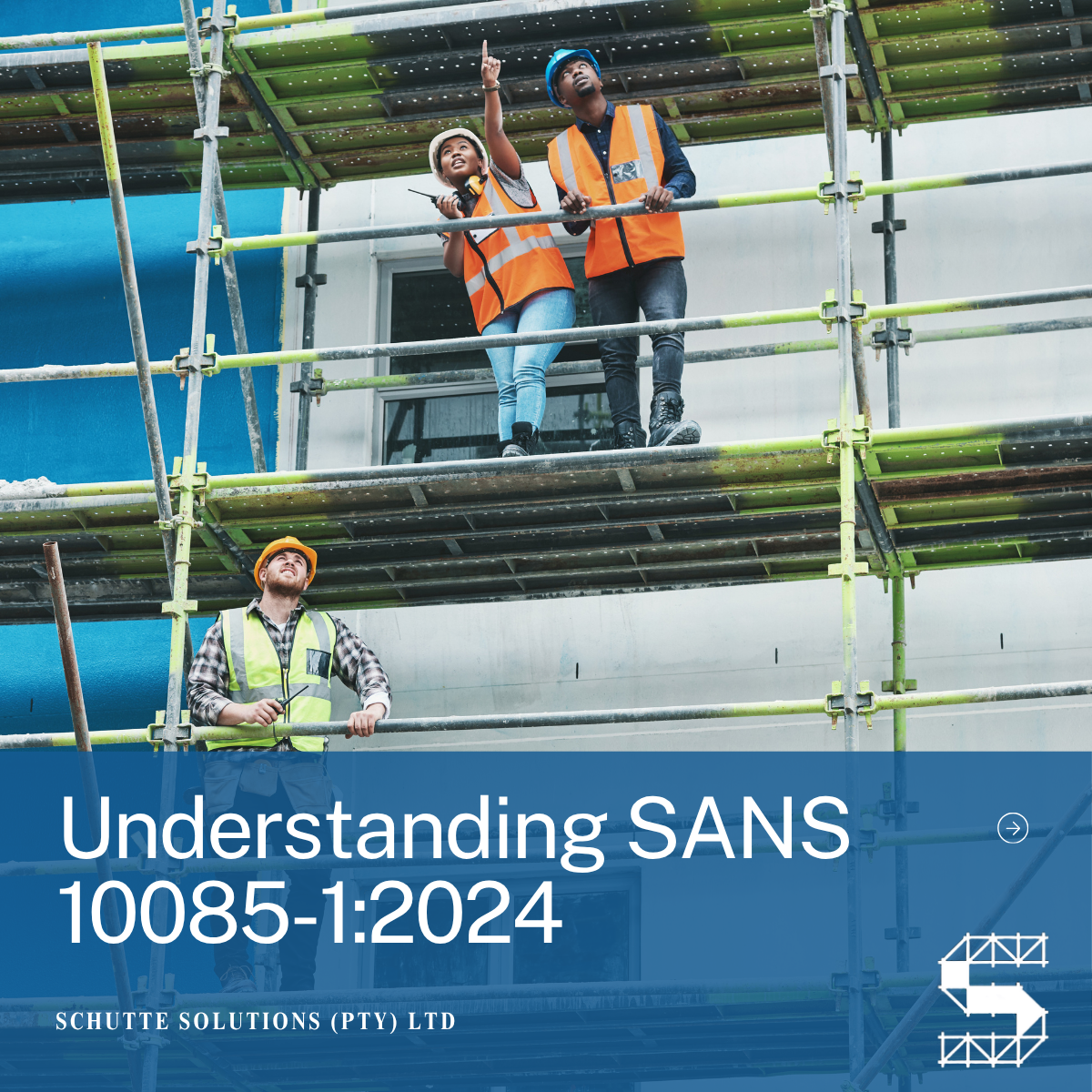
If you work in the scaffolding industry in South Africa, you've probably heard about the updated SANS 10085-1:2024 standard. While many contractors know that compliance is required, fewer understand exactly what the standard covers and how it affects everyday scaffold projects.
Whether you're erecting access scaffolding for maintenance work, industrial shutdowns, construction projects or plant maintenance, understanding the standard is essential for protecting workers, reducing project risk and ensuring legal compliance.
At Schutte Solutions, we provide scaffold design and engineering services that comply with SANS 10085-1:2024, helping contractors deliver safe, efficient and compliant scaffold structures.
What is SANS 10085-1:2024?
SANS 10085-1:2024 is the South African National Standard that provides requirements for the:
- Design
- Erection
- Inspection
- Use
- Modification
- Dismantling
of steel access scaffolding and working platforms.
The latest edition replaces the previous 2004 version and introduces updated engineering principles, clearer responsibilities and modern design requirements that better align with current international practices while remaining suited to South African conditions.
Rather than being simply a checklist, the standard provides a complete framework for safely planning and constructing scaffold systems.
Why Was the Standard Updated?
Construction methods have evolved significantly over the past twenty years.
Projects today often involve:
- Larger industrial shutdowns
- More complex access requirements
- Increased loading demands
- Greater emphasis on worker safety
- Higher expectations from clients and insurers
The updated standard reflects these changes by providing clearer engineering guidance and improved design requirements.
For contractors, this means greater confidence that scaffolds are designed for the actual conditions they will experience.
Contractor Responsibilities
One of the most important aspects of SANS 10085-1:2024 is that safety is everyone's responsibility.
Contractors are responsible for ensuring scaffolds are:
- Properly planned before erection
- Built according to approved drawings
- Erected by competent personnel
- Regularly inspected
- Modified only with approval
- Dismantled safely
The standard also requires scaffolds to be erected according to approved drawings and by trained competent persons, while ensuring adequate bracing, tying and safe access throughout erection and use.
Simply "building it the way we've always done it" is no longer sufficient.
Every scaffold should be assessed for its intended purpose before work begins.
Engineering Requirements
Perhaps the biggest change contractors notice is the increased focus on engineering.
The standard recognises two primary approaches:
Basic Scaffold Design
A basic design can be used when the scaffold remains within the prescriptive limits of the standard.
This generally applies where:
- Height limitations are met
- Load limits are not exceeded
- Approved configurations are used
- No unusual loading exists
- The scaffold follows standard layouts
Basic designs must still be completed by a competent person.
Special Scaffold Design
Whenever a scaffold falls outside the basic requirements, a special engineering design becomes necessary.
Examples include:
- Large cantilever scaffolds
- Heavy-duty loading platforms
- Drop scaffolds
- Complex industrial access
- Bridging scaffolds
- Scaffolds with extensive sheeting or advertising banners
- Unusual geometries
Special designs require more detailed structural analysis and must be completed by appropriately qualified designers with relevant scaffold engineering experience.
Why Scaffold Drawings Matter
One of the clearest requirements within SANS 10085-1:2024 is the need for working drawings.
For scaffolds where the working platform exceeds 2 metres above the lowest point, drawings are required. These drawings should identify details such as:
- Scaffold dimensions
- Load class
- Foundation type
- Bracing locations
- Tie positions
- Access methods
- Maximum loads on standards
This ensures everyone involved understands exactly how the scaffold should be erected.
Proper drawings also reduce confusion on site, improve communication between teams and simplify inspections.
Competent Persons
Throughout the standard, one phrase appears repeatedly:
Competent Person
This highlights the importance of having appropriately trained and experienced individuals involved in scaffold design, erection and inspection.
A competent person is expected to possess the necessary knowledge, training and experience appropriate for the task being performed.
Using qualified personnel reduces mistakes before they become safety incidents.
Compliance Is Good Business
Many contractors view compliance as additional paperwork.
In reality, proper scaffold design often saves money.
Well-designed scaffolds can:
- Reduce material usage
- Improve erection efficiency
- Prevent costly modifications
- Minimise delays
- Improve client confidence
- Reduce safety risks
Clients increasingly request engineered scaffold drawings before work begins, especially on industrial, mining and petrochemical projects.
Being able to provide compliant documentation gives contractors a competitive advantage.
How Schutte Solutions Can Help
At Schutte Solutions, we specialise in scaffold design that complies with SANS 10085-1:2024.
Our services include:
- Kwikstage scaffold design
- Scaffold engineering calculations
- Structural engineering sign-off
- General access scaffold layouts
- Industrial scaffold design
- Complex access solutions
- Temporary works documentation
Our goal is to help contractors erect scaffolds safely, efficiently and with confidence.
Whether your project requires a straightforward façade scaffold or a complex suspended access solution, we can provide professionally engineered drawings tailored to your site.
Final Thoughts
SANS 10085-1:2024 is much more than a legal requirement.
It represents best practice for scaffold safety across South Africa.
By understanding the responsibilities of contractors, the importance of engineering design and the value of proper planning, companies can reduce risk while improving the quality of their projects.
Investing in compliant scaffold design isn't just about meeting regulations—it's about protecting people, supporting your reputation and delivering successful projects every time.